
I concluded my earlier article (What’s in a name – Adviser voice 26th June) by flagging goals based planning (GBP) as an alternative financial planning process to the dominant yet flawed straight line risk based approach.
To refresh your memory, the diagram below depicts the goals based planning (GBP) process.
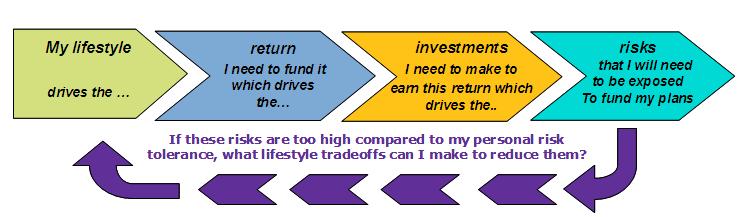
As you can see, GBP is a collaborative and iterative process designing to help client’s design their lifestyle plan based on striking a combination of tradeoffs that are right for them.
The levers available to them in designing their plan include:
- What they are spending on day to day living costs (and the savings that may or may not result)
- Lifestyle spending on their planned big ticket items such as cars, holidays and the children’s school fees
- Their planned retirement age
- Their existing asset base
- The investment returns they generate.
Many of you will immediately think to yourself…hey…wait a minute…where is the clients risk tolerance?
Well spotted if you did…back to school if you didn’t.
As stated earlier, the GBP process STARTS by getting the client to design their lifestyle plan representing as it does the combination of tradeoffs that suit them and their circumstances.
Once this plan is agreed, the planner needs to then stress test it for the client by showing them where their lifestyle plan might end up if they invested in accordance with their risk tolerance. This stress testing often leads to what I call the client’s investment risk gap. Identifying this gap and getting the client to take responsibility for it is absolutely pivotal to the GBP process and to protecting advisers in the new FoFA world.
The investment risk gap is explained in more detail later in the article.
GBP in action
Now, for many clients, the single greatest value you can provide them with in the early stages of your relationship with them happens NEXT.
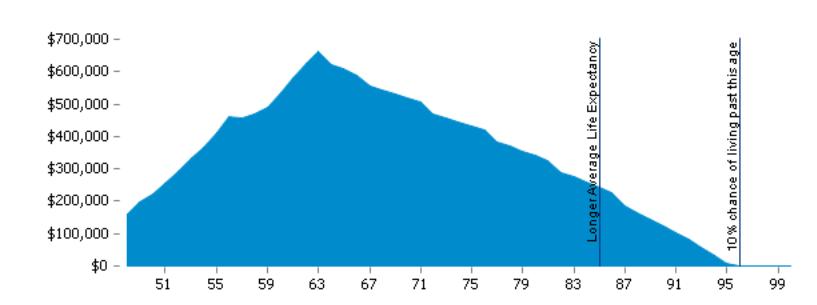
Without going into too much detail regarding their current circumstances, the 1st cut of the lifestyle plan for Dick and Dora appears below. This projection is based on an annual living cost today of $75k ($70k pa in retirement), almost no annual savings, retiring at age 60 and earning inflation plus 1% from their asset base. Let’s call these items their benchmarks.
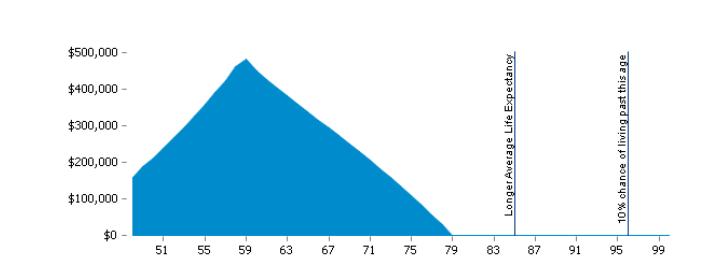
As you can see, Dick and Dora are heading for a crisis with their funds estimated to last only until age 79.
Why is this a crisis?…because the longest average life expectancy for this couple is Dora’s at age 85. Based on her life expectancy, she has a 10% chance of living beyond age 96.
So the prudent planning objective for them is to plan to have their funds last to at least their 1st goal post (Dora’s life expectancy). And in order to build some safety margin into the plan, aiming to get their assets to fund them as close to their 2nd goal post as possible (or even slightly beyond) would make sense.
Now for the tradeoffs
With the right modeling tool at hand you can now walk Dick and Dora through an iterative process that helps them to understand the relative impact of changing one or all of their benchmarks in a way that makes sense to them.
For the sake of brevity lets say that by reducing their current living cost by $100 per week and by $200 per week in retirement AND increasing the target returns on their investments to inflation plus 4% today and plus 3% in retirement AND delaying their retirement to age 62 respectively we get the following projections.
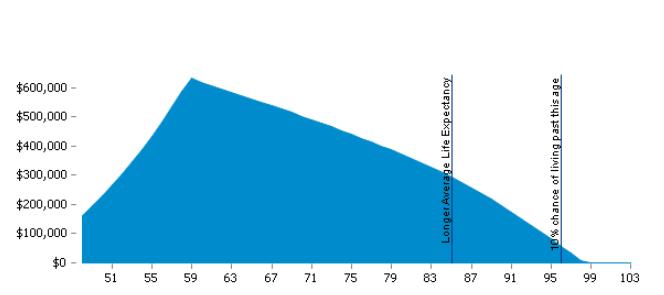
While these changes appear to achieve a terrific outcome for Dick and Dora, when they add the following plans into the mix, their projections unfortunately come crashing back to earth.
- A car replacement every 3 years at a cost of $25k for each changeover
- A family holiday of $10k every 2 years for the next 30 years
- Uni fees for their daughter of $30k each year for 4 years starting in 5 years time.
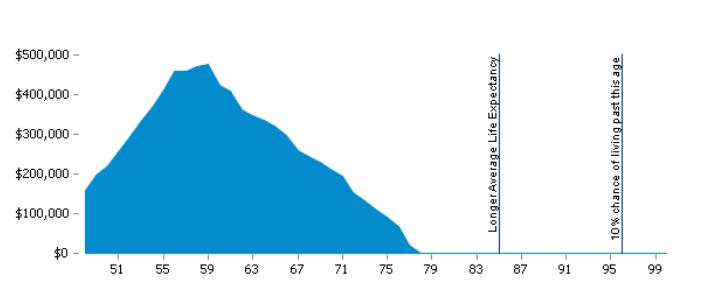
The impact of these big ticket items is devastating with Dick and Dora losing around 21 years lifestyle funding.
Finally we can see that Dick and Dora can get their plan back on track by making the following adjustments:
- Reducing their annual living cost now and in retirement by a further $5k
- Delaying their retirement to age 65
- Reducing the cost and frequency of their car replacements.
Now apply their risk tolerance
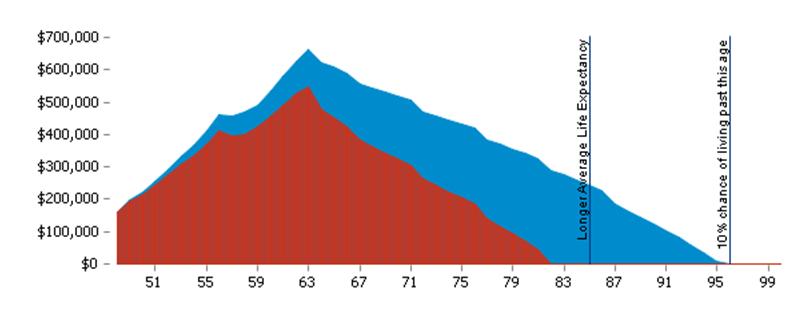
With their 1st lifestyle plan agreed and the tradeoffs decided, their adviser then decides to stress to test their plan by recalculating it using a return target that corresponds to the lowest risk tolerance between Dick and Dora. In my example Dick’s risk tolerance has been assessed as “low” which I attach a target return of just inflation plus 1% for this calculation. This change produces the following projection.
 ‘
‘
In the above example, this last graph shows in clear, unadulterated terms what I call the clients investment risk gap.
Put simply the clients investment risk gap occurs when a client’s target return (in combination with their other benchmarks) is higher than the target return associated with their lowest risk tolerance.
In my example, an investment risk gap exists because Dick and Dora are:
- Targeting a return of inflation plus 4% and 3% which helps fund them to age 95; which is higher than the
- Target return of inflation plus 1% which equates to their lowest risk tolerance. Using their risk tolerance they might only fund their lifestyle to age 82.
By expressing the investment risk gap in years (13 years in this case), clients can instantly see the impact on their lifestyle should they decide to invest in accordance with their risk tolerance.
So…what to do about this gap you might ask?
Well there are really only too courses of action available to the client.
Firstly they can continue to trade off their lifestyle goals by reducing their living cost yet again or perhaps they could both agree to pay for their daughter’s books at uni but she might have to use the HECS system to fund her tuition. Both these tradeoffs would enable Dick and Dora to reduce their target return to a number closer to their underlying risk tolerance.
Or…secondly…they could live with their investment risk gap.
Taking responsibility
If Dick and Dora still have an investment risk gap after making all the tradeoffs they are prepared to make, they must take responsibility for it.
In my world, I don’t even start to draft an SOA for a client until I have on file a signed declaration from the client stating that they:
- Know they have a gap
- Know what the gap is and why their gap exists
- Know the consequences of maintaining a gap; and that they
- Take responsibility for it.
Conclusion
In my view, a goals based planning process that incorporates a risk tolerance stress test is simply the most robust and sustainable process to attract, engage and retain long term fee based clients.
Over the last 30 years as an industry we have been guilty of selling at various times tax, super, Centrelink and investment arbitrage as the basis of our value proposition to our clients.
While all of these elements are critical to the overall financial planning process, GBP is real planning. GBP helps the client to articulate WHAT THEY WANT to achieve as a result of their planning. Investment strategy, tax, super and Centrelink planning reflect HOW WE IMPLEMENT their plan.
In my final article on the planning process for Adviser Voice, I’ll provide a detailed account of the staggering commercial consequences of uniformly adopting GBP across a planning business by calling upon my experiences at IPAC Securities back in the late 90s.
9 July 2012


