
Let me start by thanking AdviserVoice for giving me a forum to express some long held beliefs and views about the financial planning industry, its practises and institutions.
AdviserVoice should be commended for resisting the current trend among the financial press to editorialise the content on the site, and for that reason alone, AdviserVoice deserves our support.
It’s the process stupid!
Forgive me for my “loose” use of the phrase used by the Clinton presidential campaign crew in 1993 (i.e…the economy stupid) to describe what I think is an absolute truth that can be applied to the financial planning industry.
When I received my first proper authority in 1985, I was taught that the financial planning “process” starts by asking the client what their attitude toward investment risk is. Armed with the clients answer, the planning process that followed was straight forward enough.
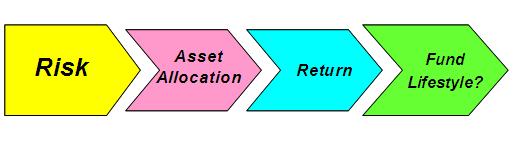
Now any thinking financial planner knows that this approach is fundamentally flawed.
In the first instance it clearly isn’t a process in the strict sense of the word. Processes generally contain feedback loops to continuously feed outcomes back into the process to check and verify results along the way. None of that exists in this straight line approach.
To put it bluntly, this “process” is nothing more than an expedited portfolio picking approach designed to get products in front of clients as quickly as possible.
The second flaw embedded in this approach is that few advisers actually do the detailed cash flow modelling required to work out whether the client’s risk decision is going to generate sufficient returns to fund the their lifestyle over the long term.
Failure to do this modelling was one of the deficiencies cited by ASIC following the recent shadow shopper trials.
Risk based decisions
Who in the industry…be they advisers, dealers, institutions or regulators…honestly and truly believe that a client can make an informed decision about their attitude toward investment risk following a 30 minute discussion with the planner and a questionnaire.
Following this discussion, how many clients really think to themselves…?
- Time not timing and diversification
- Two standard deviation measures of return based on rolling five year periods
- The relationships between risk, return and lifestyle funding.
The truth is almost none of them.
In my experience, when clients hear the word “risk” almost all of them think about the chance of losing their capital and it takes time, patience and repeated sessions and lessons before they gain a more sophisticated view of what risk really is.
From the client’s perspective, an approach that starts with an unknown…risk…and ends in an unknown…funding lifestyle…is simply doomed to fail and to ultimately play itself out in the courts with monotonous regularity.
Divergent risk tolerances
In addition to these fundamental problems, another flaw of the “straight line” risk approach relates to how advisers manage the very common situation where couple clients have divergent risk tolerances. See the diagram below.
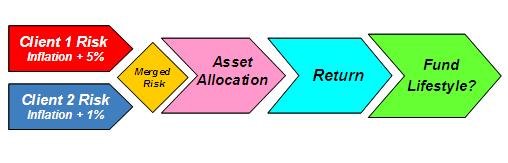
And how do most advisers manage this situation? They recommend a compromised risk position. In the example above, lets say both partners are convinced to adopt inflation plus 3% as a compromise risk position.
In doing so, the adviser has now put themselves, their dealer and their business at risk!
How? In the first instance the adviser has recommended this risk position to the client rather than the client arriving at this decision by themselves, with the full knowledge of the impact this decision will have on their future.
When the client’s investments go pear shaped in the future and they decide to drag the adviser and their dealer into court, all they need to say is that they didn’t understand the risk.
Let me ask you…what evidence do most advisers have on file to present in court in defence of their assertion that any reasonable person should have understood the risks. Remember, a defence based on a “buyer beware” argument is unlikely to succeed in an environment where the regulator and the courts are moving toward a fiduciary standard for the industry.
The other problem that emerges from adopting a compromise risk recommendation relates to the advisers business.
Often, the consequences of adopting a compromise recommendation are to all but guarantee that 50% of the adviser’s client base is going to be upset with them.
When markets move up, the more aggressive partner will be thinking to themselves “…if only they listened to me” we would be getting all these higher returns. When markets move down, the more conservative partner will be thinking to themselves “…if only they listened to me” we wouldn’t be suffering all these losses.
What’s the alternative?
As an absolute minimum, a robust financial planning process must have the following two elements.
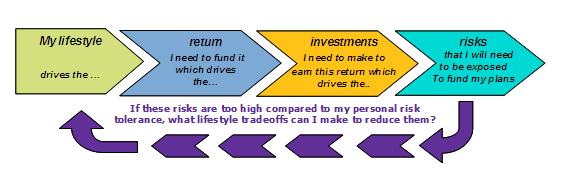
Firstly it must have a feedback loop which enables clients to iteratively see the dynamic relationships that exist between:
- what they want out of life
- the return (and savings in some cases) needed to fund their plans
- the length of time they need their financial resources to last.
Secondly, the process has to get the client to understand the impact that their risk decision will have on these lifestyle outcomes…and to own this decision!
What I am referring to here is goals based planning process…an often referred to process, but one which is so often misunderstood.
 In my next contribution, I will describe goals based planning in detail, explain how it deals with the shortcomings of a “straight line” risk based approach and then finally explore the legal, commercial and compliance benefits of using this process with your clients.


