
Beyond the hedge – lessons from a decade of alternative investing

Looking beyond the Hedge.
Advisers and their retail clients cast a wary eye whenever the expression ‘hedge fund’ is raised.
Why so? Institutional investors have embraced alternative investing with great vigour, while the regulator, ASIC, has recently allayed fears concerning the underlying liquidity and gearing levels of Australian hedge funds. Alex Wise gives an insider’s view on the journey for hedging from lowbrow blunt instrument to today’s legitimate tool in the investor portfolio kit bag.
The alternative investment industry has grown substantially in size since the lows of the GFC (from a low of around USD 1 trillion to over USD 2.3 trillion today[1]). Institutional investors particularly endowment funds, pensions, sovereign wealth funds (e.g. the Future Fund) have markedly increased their use of alternatives in their portfolios. Alternative strategies (such as hedge funds and managed futures) and alternative assets (such as commodities, private equity, infrastructure and gold/precious metals) have formed an important part of that strategy.
Yet for retail investors the hedge fund has struggled to overcome negative perceptions – understandable given that hedge funds often take conflicting positions to other investors by going short on equity that they believed to be over-valued. Closer to home, a recent ASIC report[2] notes that Australian hedge funds do not pose a systemic risk to the financial system, because they have low levels of gearing and adequate liquidity.
At Select we have been investing in alternative managers since 2002 and in 2004 we launched a fund tailored to alternative investments. During this time we have learnt a lot about the asset class.
What are alternatives and what are hedge funds?
In summary, both terms are somewhat ambiguous. Alternative investments In Regulatory Guide RG240 ASIC sought to define a hedge fund but ended up categorising a large proportion of the investment industry as hedge funds!
We define a hedge fund or an alternative fund by its investment strategy – therefore avoiding broad “catch all” definitions. Typically hedge funds exhibit an alternative investment strategy. This means the main portfolio objective is to do something other than purchasing (long) equities or bonds (traditional investing). Some examples of what we consider hedge funds are set out below. Often the descriptions of strategies can be quite technical, so I have sought to apply how Select defines some of those strategies below.

Portfolio Construction: What are the key trends in alternatives investing?
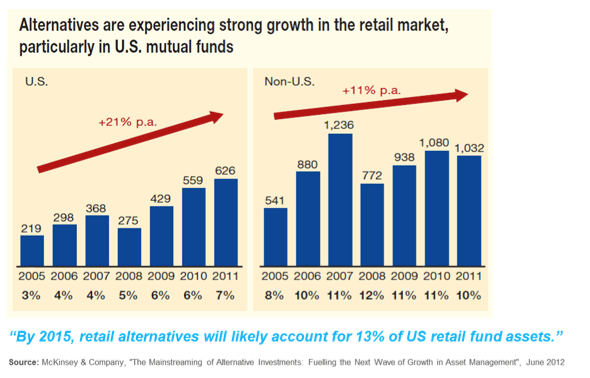
It is now a widely held belief that investors should have some alternatives exposure either directly into a portfolio of funds or into a diversified alternatives portfolio (also known as a fund of funds). In a recent survey McKinsey noted the growth in alternatives particularly amongst retail investors in the United States:
What should I consider before investing in alternatives?
First of all – we all know that past performance is not indicative of future returns so after a cursory glance at long term and recent performance be prepared to consider a wide range of additional due diligence issues. Advisers should consider capacity, transparency and liquidity when evaluating the appropriateness of a particular alternative strategy/asset for a client.
Capacity
Capacity is important to ensure that the manager can deliver its strategy as its assets grow. Many strategies are niche and too many assets may indicate a successful marketing machine but not necessarily a good long term performance engine.
LESSON #1 – Objective due diligence
Previously investors has sought to chase returns or chase perceived quality. Following the herd into an investment has proven ill-advised on many occasions. Just because a fund is large or “exclusive”, that doesn’t make it a good investment. Wealthy Swiss investors found this out the hard way with Bernie Madoff!
KEY CHECKS – how much have fund assets grown? Track performance over the same period along with performance of an appropriate index… Note significant asset raising versus average performance relative to the index.
Transparency
Avoiding funds that are not open about their investment strategy is vitally important. Many funds harbour secretive strategies behind such terms as “proprietary trading systems”. These funds are unlikely to be engaged in nefarious activity however investors should place high value on clarity of what the fund invests into. This is one easy way investors could have avoided Bernie Madoff’s fund, the biggest managed fund fraud in history, exposed in 2008. An increasing number of fund of funds are able to look through into the holdings of the underlying managers ensuring that the additional layers do not obscure the ultimate underlying investment.
LESSON # 2 – Transparency
When I first joined the hedge fund industry in 2002 the London based firm I was working for had an investment with a US fund called Beacon Hill. Whilst our investment team liked the principals and felt the strategy was solid, transparency within the portfolio and governance process was questionable. We learned the hard way when the fund lost 50% of its value by doubling down losing bets and conjuring up a false unit price. After this we invested a lot in transparency and operational due diligence to check the portfolio and the unit pricing process.
KEY CHECKS – what reports are available to an investor? Do you get a breakdown of the entire underlying portfolio? Also ask for the Fund’s audit report. Does the report show the underlying assets – if not ask why!
Liquidity
Despite the rapid recovery of the industry, the growth of alternatives has actually been held back by many funds lacking the ability to provide desired investor liquidity. In a recent report “Rise of Liquid Alternatives Survey” Citigroup sees global demand for liquid alternatives from the retail audience reaching $US939Bllion by 2017 and $US1.3Trillion including institutions seeking greater liquidity. They note that this would make the liquid alternatives market nearly as big as the entire hedge fund industry at the end of 2008.
LESSON # 3 – Underlying Liquidity
Many hedge funds began investing in private equity assets in 2006 and 2007. When liquidity dried up in the markets (there were no buyers), these assets became impossible to sell. Some pension funds still have these assets on their books.
KEY CHECKS – Does a multi-manager have significant look through to the underlying assets? What liquidity does the fund offer? Can an independent risk manager prevent the sale of illiquid assets?
What about Fees?
Trends from the United States indicate that fee levels in alternative strategies are reducing – or improving for investors. However investors should carefully review all fees – particularly performance fee structures – that may contain surprises for the unwary. However it is our experience that many hedge funds targeted at US retail investors are now offering structures with no performance fees at all.
For retail investors, unless they are investing through a fund of funds, the choice of alternatives will be limited to those that can offer their products in Australia. This limits the investment universe for retail investors, with many preferring the fund of funds route to gain access to institutional quality managers offshore. The Australian alternatives markets can limit the strategies available particularly in an increasingly global world.
KEY CHECKS – how does the performance fee work? Does it apply to unit holders as a whole or each individual investor? If the fees seem low – ask why. Are they being hidden by a swap or similar arrangement?
Summary
The alternative investment industry has evolved substantially since the lows of the GFC and many believe they offer substantial benefits to a diversified portfolio. The industry must however be able to deliver capacity, transparency and liquidity along with cheaper fees to match the goals of retail investors in Australia. At Select we believe that change is happening. Global investors (including the bellwether of US retail investors) are steadily increasing the use of alternatives in their portfolios, as they also believe better conditions prevail to ensure lessons have been learnt since 2008.

[1] Source: Prequin
[2] ASIC Report 370, The Australian hedge funds sector and systemic risk. September 2013
Note: The accreditation for this CPD article is no longer current. Please visit our CPD section for current CPD quizzes.


