
1.0 Introduction
Fidelity International’s analysts, who are at the heart of Fidelity’s investment process, actively meet with and review over 90% of the world’s largest listed companies on behalf of our over five million customers across Europe and Asia Pacific.
Our proprietary ‘bottom-up’ research is central to Fidelity’s investment process. Developing this research relies heavily on the quality and caliber of our analysts. They must have strong and independent thought, show a commitment to unearthing new and exciting investment opportunities, and work as a team with our global portfolio managers to buy and sell stocks at the right time, at the right value.
Every day a Fidelity analyst is meeting with a company, talking to its senior management or being briefed by its many stakeholders. They therefore develop an in-depth knowledge and thorough understanding of a company, its competitors, management, suppliers and clients.
These analysts are in a unique position to gain insights and thoughts from some of the world’s leading companies about their ideas for the future, their insights into current trends, and their plans in terms of capital expenditure, expansion, mergers and acquisitions.
To gain a better understanding of these themes and take a closer look at the more interesting issues facing some of Asia Pacific’s listed companies during 2011, we asked our fixed income and equities analysts to respond to a survey in December of last year.
The survey asked over 60 Asia Pacific Fidelity analysts to outline general themes, issues and opportunities they were hearing or witnessing from the companies they cover during Jan – Dec 2010.
This report is a snapshot of this knowledge across the Asia Pacific region which we hope you will find interesting and helpful as you make your own investment decisions.
3.0 About Fidelity
A global leader in investment management
Fidelity International is a global leader in investment management. Established in 1969, Fidelity has a presence in 23 countries and territories around the world and employs 4,676 people. Investment management is Fidelity’s primary business, managing US$231.6 billion in assets for millions of customers – major institutions through to individuals – spread over more than 750 equity, fixed income, property and asset allocation funds. Fidelity’s research spans the world – over 350 investment professionals within Fidelity International plus over 650 from associated companies contribute to and share the investment insights used by our portfolio managers.
Fidelity’s research and analysts
Fidelity adopts a research-driven, bottom-up approach to portfolio construction. As active managers, we believe that markets are only semi-efficient, meaning that markets, sectors and stocks can be overvalued or undervalued at any point in time and that research can uncover profitable opportunities.
Fund portfolios are built from the bottom up, security by security, taking account of general market trends but not being driven by them. Portfolio managers are responsible for their funds and encouraged to develop their individual flair, while benefiting from global research contributed to and shared investment professionals within Fidelity International and associated companies.
Analysts contribute to global research, undertaking extensive inquiries at all levels of a company to understand how it is positioned to deliver results for investors. Whether equities, fixed income or property-related funds, it is only through this first-hand contact with companies – rather than relying purely on a non-affiliated firm’s research – that they can fully evaluate an investment’s true potential and consistently add value for investors.
Fidelity analysts and portfolio managers across the globe access senior company management, their offices, their plants and factory floors. They talk to company’s suppliers, distributors and customers to build a three-dimensional view of every company in which they invest.
4.0 Key findings
Asian consumer bolsters another solid year of growth ahead
Revenue and operating profits
Over 77% of analysts said the companies they met with during 2010 are likely to see improved sales flows of 10% or more in 2011.
50% of analysts said they expect operating profits to grow in excess of 10% in 2011. This expectation is typical for Asia Pacific companies and in line with previous years, confirming that 2011 will be yet another year of solid growth levels for companies across the region.

Measurements used
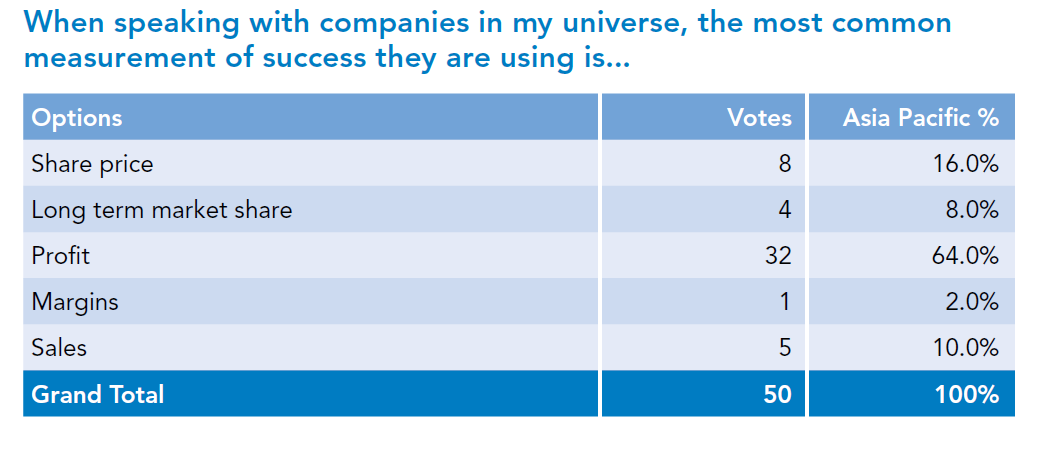
- Profitability continues to be the most common measurement and key driver of success by management in Asia Pacific companies (64%) followed by share price performance (16%) and sales (10%).
Time horizons
- With respect to time horizons, most companies (66%) in the region are focused on delivering 2-3 year strategies, adopting a medium to long term view overall which is again, a common benchmark in Asia Pacific organisations.

The Japanese profit imperative
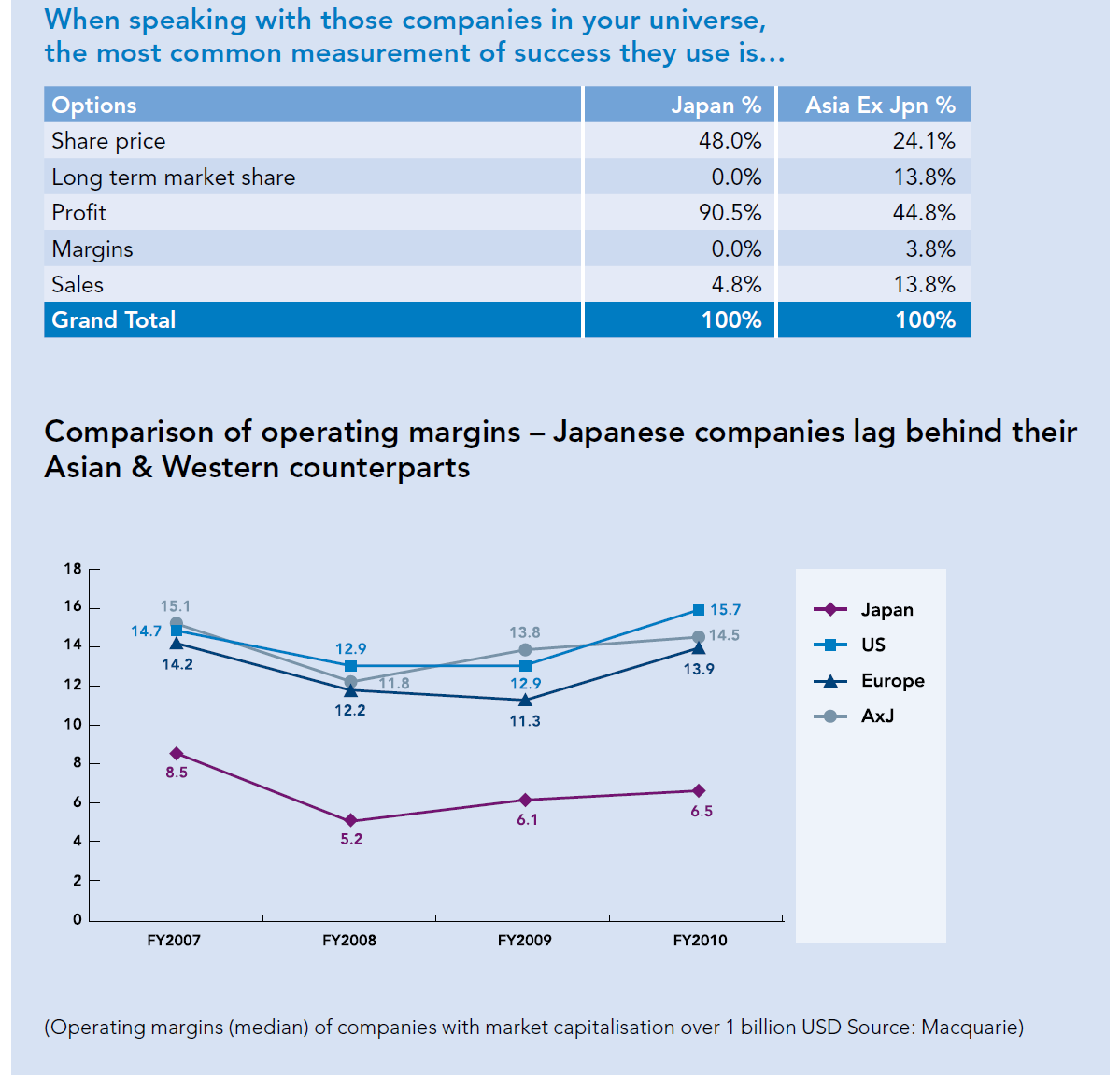
That profitability is a key determinant of a company’s value should come as no surprise, particularly in a weakening global economic outlook. The Japanese market, however, takes this metric to the extreme: 90% of respondents indicated it was the primary measure of success. The structurally lower margins in Japan (which relates to such issues as too much competition, lack of a competitive takeover culture, unwillingness to allow clearing through bankruptcy, etc) may indeed be the reason for management to have a more intense focus on it. The issues are however, structural so any focus on profit may not necessarily result in any rapid improvement in the situation.
The Asian consumer
The top theme fuelling this profit and sales growth that analysts indicated is linked to Asian consumption growth. In contrast with the west, retail and consumption in Asia have shown remarkable resilience, even through the crisis. Asian retail sales volumes increased by 4.8% in 2009 and 5.7% in 2010, according to the Economist Intelligence Unit, with annual growth accelerating to above 6% to generate a remarkable US$8.7trn in sales by 2014. China – the one market in Asia where private consumption is importantly growing faster even then GDP overall – in particular is being seen as a regional growth engine, and this was a key theme that underscored our analysts’ observations.
In particular, China’s consumption story loomed large as a theme for our analysts. Yet, China is by no means the only component of the Asian consumption story. Outside of China, emerging Asia not only has strong domestic demand – but also a demographic dividend to go with it. India has a rapidly expanding middle class, and an overall labour force expanding by a world-beating 2m a year. Growth in Indonesia’s domestic consumption market, which now makes up 60% of its economy, recently climbed to a 18-month high of 5.2%.
Moreover, this consumption story is no longer limited to a single market sector or product category theme. Our analysts saw growth in numerous areas, such as autos, infrastructure, healthcare, luxury products.
All cashed up (and looking to spend?)
Balance sheet strength
63% of our analysts feel the balance sheets of the companies they cover are strong, very strong or extremely strong. Whilst none of these descriptions necessarily implies “too strong”, clearly companies in Asia are now carrying too much cash on their balance sheets. This is a natural reaction to coming through a deep recession and credit crunch. In Asia, the lessons were learnt in 1997, and companies have run strong balance sheets ever since. This stood them in good stead in the 2008 credit crunch. History would indicate that as confidence returns, companies will no longer see the need to hoard so much cash, as it lowers return on equity. But are we seeing evidence of this yet, and how will they deploy the cash?

Around a third of our analysts (29%) detected a change in attitude and approach to managing this cash surplus. This was the case for Japan as well, where several of our analysts sense that companies have moved on from taking a defensive stance of hoarding cash. Given the bloated nature of balance sheets, some may view this result as a disappointingly low number. However, it seems that some companies may require more time to feel confident enough in the global recovery to deploy their cash piles. Those who do however, plan to deploy the surplus, intend to spend it during 2011 in three key areas: dividend payouts, capital expenditure and acquisitions. In Japan, the primary focus is likely to be dividend payouts (42%) compared to Asia with a primary focus on capital expenditure and acquisitions (both ranking at 30% each).
Higher dividend yields and share buy backs are both positive to the Asian market growth story. If you have underlying revenue growth of 10%, there is likely to be some operational gearing, and earnings growth should be significantly higher. In addition, you can add the dividend yield to calculate total shareholder return. If this holds true, equity shareholders in Asian companies can look forward to good capital growth coupled with increasing income; a double-benefit to returns.

Capital expenditure and expansion
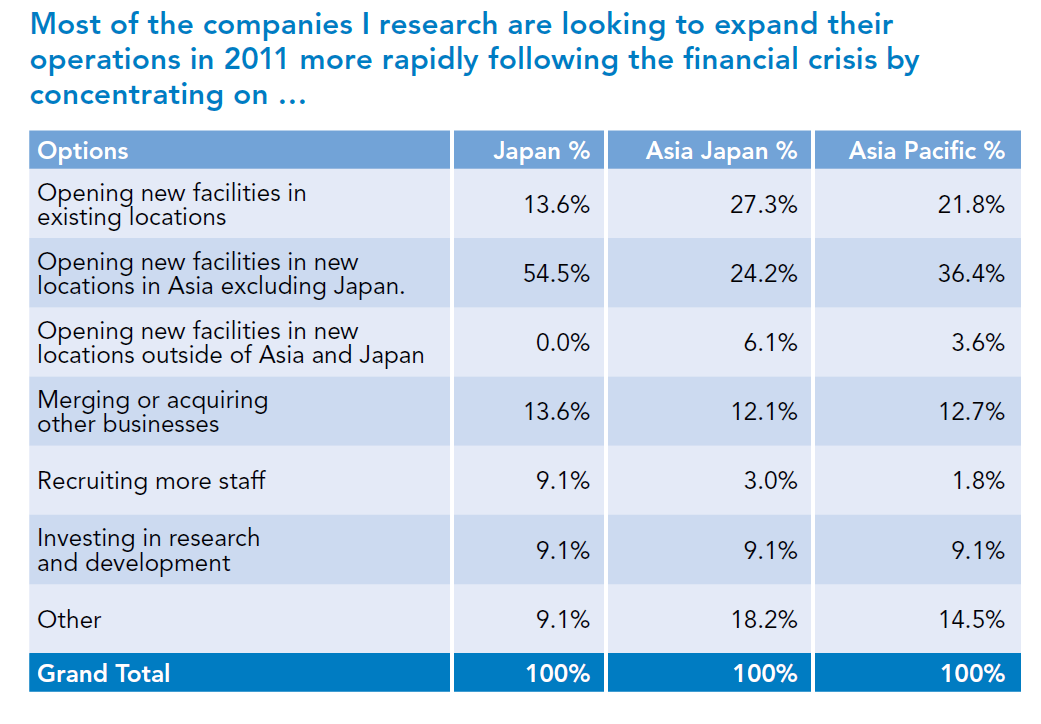
Most analysts believe the companies they cover are looking to expand their operations in 2011 more rapidly by opening new facilities in locations throughout Asia but outside of Japan (36%), or opening new facilities in existing locations (21%).
Interestingly, more Japanese companies have indicated their intention to expand in Asia ex-Japan compared to Asian companies (54% vs 21%).
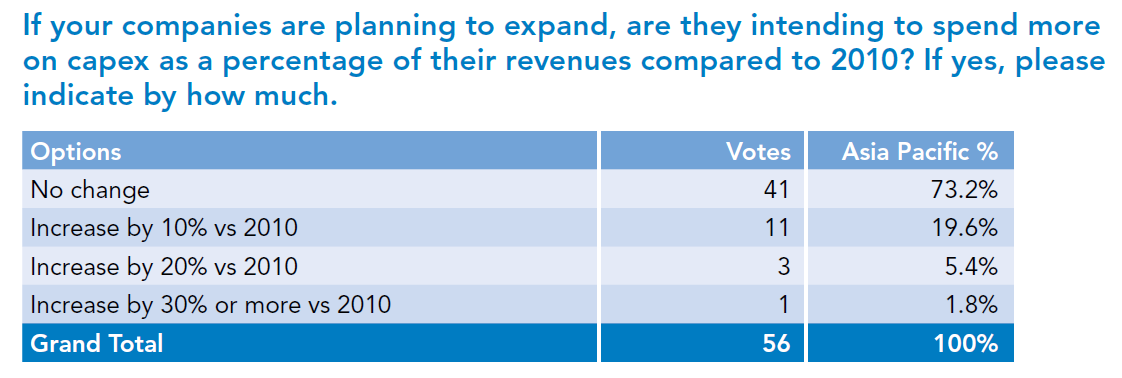
The majority of companies that are looking to expand in 2011 do not intend to increase their capital expenditure as an overall percentage of their revenues (73%) and will use their expected dollar increase in overall revenues to build up their business; reinvesting in the Asian growth story and driving organic growth. So companies are looking to expand but the rate of expansion is not expected to increase. Instead, it will grow in line with sales, and thus perhaps in line with free cash flow growth. As a result, this may not equate to any serious reduction in cash piles as capex will be offset by incoming operational cashflows.
The US recovery matters
Recognising that domestic profit growth in the region is also reliant on non-Asia Pacific-related economic conditions, many analysts indicated that the US economy in 2011 will be a key factor that they and the companies they cover will be watching. The impacts of a further decline or even signs of further recovery were noted as a key factors that could impact the growth momentum of Asia Pacific companies.
However, the developed world and the exports demanded by the US, are still a very important engine of growth for many Asian companies. If global demand diminishes, those companies in Asia that are focused on exports will suffer and as a result, analysts continue to believe that the outlook for the US and European economies remains an important factor.
According to the World Bank’s latest “Global Economic Prospects”, domestic demand in emerging economies accounted for over half of global growth in 2010. The developed world grew at 2.8% whilst the emerging world grew at 7%. However, the developed world and the exports demanded by the US, is sill a very important engine of growth for many Asian companies. If global demand diminishes, those companies in Asia focused on exports will suffer and as a result, analysts continue to believe that the outlook for the US and European economies remains an important factor.
In addition, the concentration on expanding production or sales capacity in China and other Asian markets, provokes the question “can the Asian growth accommodate all this expansion?” The US recovery is needed to help absorb some of this new capacity and sustain the growth momentum.
Some of our analysts also focus on the rise of intra-Asian trade and how this will impact Asian companies. It’s important to note however, that intra-Asian trade often involves the shipping of components (from Japan to China for example) for final assembly and ultimately destination to the US and Europe. The iphone is a good example – designed in California, it is assembled in China by a Taiwanese company using components made in Japan (Japanese components account for about a third of the iphone’s material costs). So, domestic demand in Asia and developed market demand in US and Europe are both key drivers of future success.
Global leadership vs global mindset
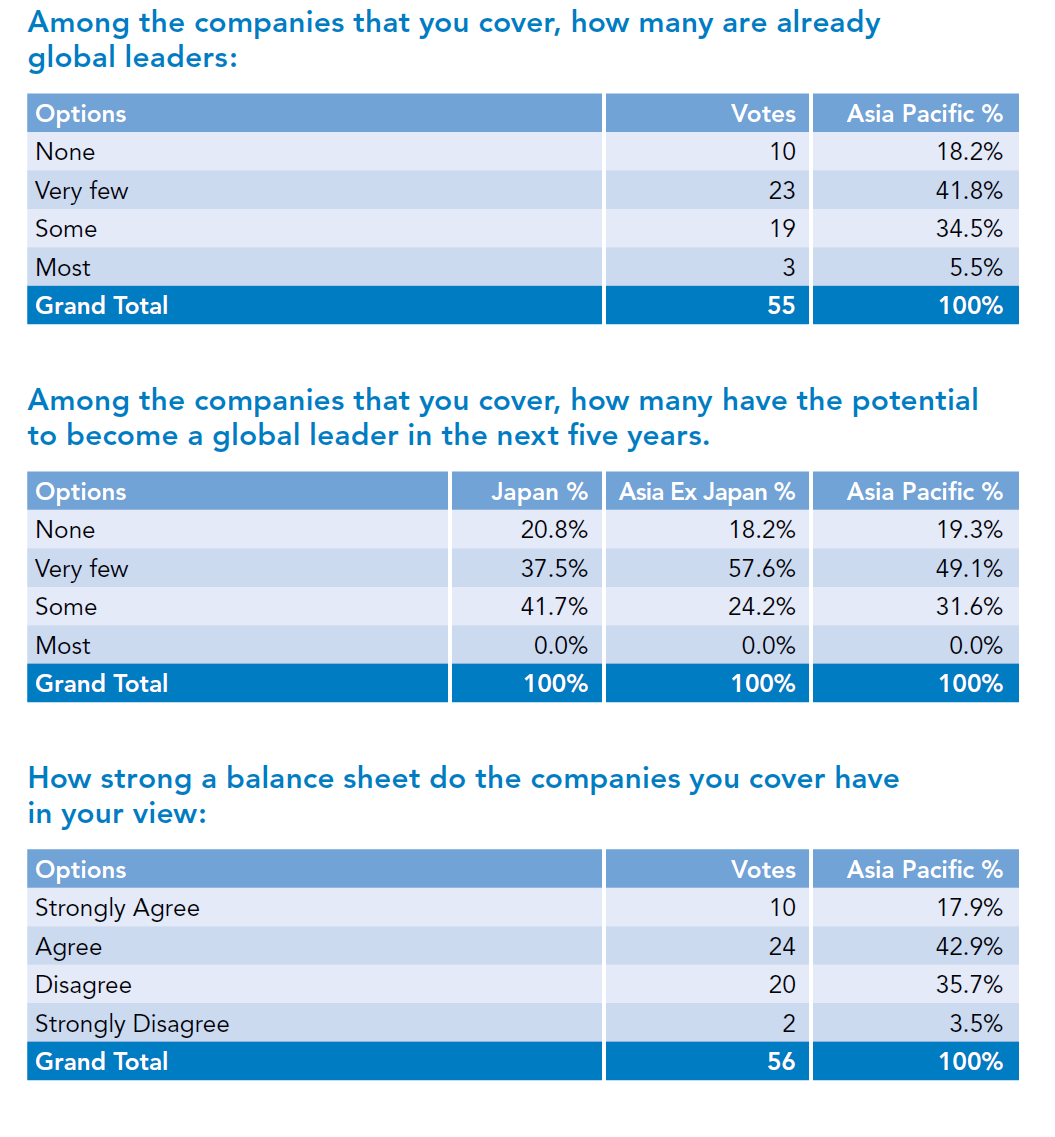
Very few of the companies analysts met in the region during 2010 are already global leaders and very few, in the eyes of our analysts, have the potential to become global leaders in the next five years.
The vast majority of companies do, however, have a global strategy as well as management teams who actively consider both global opportunities in addition to domestic ones.
 Certainly, a number of firms from Asia have become household names globally, largely through scaling up domestic market competencies into international positions through market share acquisition: hence India’s world-beating business process outsourcing sector, or Korea’s digital device giants, or Australia’s leaders in the ‘rocks and crops’ space.
The traditional sense of going global, i.e. providing globally competitive products and services to win market share away from home, may be changing. For Asian companies busy capturing growth opportunities in their home ground, venturing into global markets and investing into developing globally attractive products may not be a high priority. This becomes a slightly different story for Japan, where globalisation is a requirement to grow for some companies.
Japan and China still on track
Whilst local and global consensus tends to assume that Japan’s maturing economy will cripple Japanese enterprises ability to head global competition, our Tokyo analysts point out that Japan will continue to generate global leaders. Half of our Tokyo analysts say that their sectors already have some or many global leaders, and 42% say some companies in their respective sectors have the potential to become global leaders in the next five years.
Most of these sectors already have proven global leaders today (such as electronics, auto & auto parts, machinery, trading companies) but few new faces have the potential to make it to the global league tables such as the internet or entertainment sectors.
Outside Japan, we tend to think of Samsung, LG and Hyundai and think the list stops there. But actually there are more Asian leaders than we think, typically in non-branded areas such as the Indian generic pharmaceutical companies or for example, the Chinese dominance in rare earths.
Corporate governance
Half the analysts surveyed said it will take 10 years or longer for the companies they meet within Asia today to adopt global standards with only 2 1% of companies operating at this level today.


A different perspective in Japan
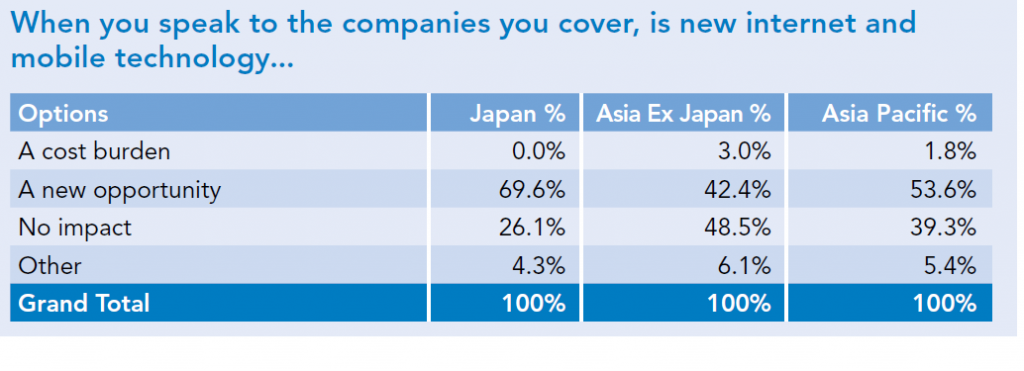
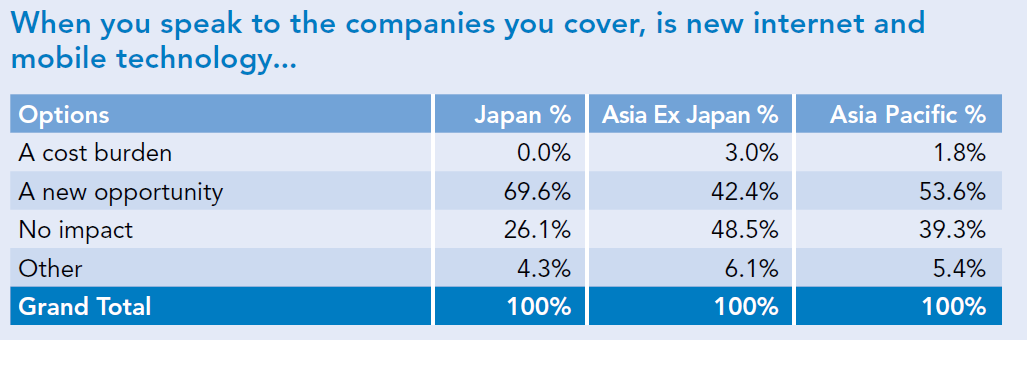
It bears noting that Japanese responses are more enthusiastic about the opportunities that these technology trends offer. Today Japan already is a global leader in manufacturing display screens, ICs and chipsets which are critical inputs into the supply chain, and our Tokyo analysts highlight additional interesting growth opportunities, such as tablet computing, mobile gaming and payment platforms, and display technologies. The Japanese government’s huge commitments (through subsidies and incentives) to push its companies into global leadership positions in green technologies likely make climate change a more tangible and exciting opportunity there than in the region as a whole.
 Key challenges and issues
When asked to identify the leading challenge facing companies in 2011, the three most popular themes our analysts raised were as follows:
- 25% Regulation: government policies, tax, government spending and political uncertainties
- 20% Inflation: Inflation causing rising costs, rising interest rates, fiscal tightening
- 10% Competition: price competition, pricing pressure, foreign competitors, domestic consumption
- 29% of our analysts are concerned about governments tightening their grip in areas such as preventing oligopolistic markets, enforcing product liability, controlling labour standards etc; reflecting governments’ keenness to keep an eye on consumer protection as private consumption becomes a key growth engine for the region.
Whilst regulation and competition are perennial factors that concern companies and analysts, inflation is the biggest new concern. Expressing itself through higher wage costs and higher raw material costs, it is likely to be a big headwind for many companies this year
The consumer, whilst more confident than in 2009, may not be robust enough to absorb a pass-through of higher costs.
6.0 The final word
Matthew Sutherland, Head of Research, Asia Pacific, Fidelity International
“If there was nothing left to worry about, markets would be at a peak. But there is plenty left to worry about – persistently high unemployment in the US, fiscal belt-tightening in the UK, the seismic cracks appearing in the fabric of the Eurozone and its currency, monetary tightening to arrest inflation in China. I expect the bull market to go on ‘climbing the wall of worry’ this year.
Companies are indicating significant levels of revenue growth this year. This is good news, and should provide the bedrock for another strong year of market performance. The potential fly in the ointment here is likely to be inflation. It is expressing itself via higher wages and higher raw material costs, and could result in margin expectations being reduced as the year goes on. This would not be atypical – it’s the reason “sell in May and go away” works as a market adage.
Aside from revenue growth, additional benefits will come from an increased willingness of companies to do something constructive with the overly-large cash piles they built up as a reaction to the problems of 2008/9. Interestingly, whilst they will spend on capex, capex will not grow as a percentage of sales. More importantly, they are likely to give more back to shareholders via increased dividends and buybacks. We should thus have a year with good earnings growth coupled with higher yields and buy-backs, which makes for much higher total shareholder returns.
It’s interesting that analysts are still focused on the US economy. They are right to do so. Whilst domestic demand in emerging market accounted for half the world’s growth last year, according to the World Bank, the other half of the world’s growth came from other areas, and the US economy is still the world’s largest. So at the margin, its success or failure to recover can make a big difference to companies’ ability to grow, especially in the export areas of the economy.
The analysts did not really mention this, but the longer term worries in my view include social unrest and political instability resulting from higher food costs, water shortages, and the growing disparity between rich and poor.”
Hiroki Sampei, Director of Research, Japan, Fidelity International
“The results tell us that companies across Asia Pacific continue to expect a strong Asian consumption demand, as the middle class grows and urbanisation progresses. Another interesting point is that many of our Asia ex Japan analysts are more concerned about a supply shortage in workforce, energy, infrastructure etc to back up this growth, rather than an over supply of production capacity.
With so much expectation on the Asian Consumer engine, we need to be levelheaded about how far earnings growth can be sustained by this single engine. This is why the US recovery does matter for the Asia Pacific companies to continue their path of healthy growth. On the contrary, when the US recovery happens, this may potentially fuel inflation which many of our analysts have flagged as a potential bottleneck for growth.
The daily company visits and research activities conducted by our analysts, aggregate into a vast database of information that help us develop our own understanding of what is happening from a macro perspective. Another advantage for us, is that our approach allows us to take in what is happening even before the macro statistics are released. From here we identify the risks and opportunities that may impact the companies we research and apply this insight back into our stock picking.”
Sabita Prakash, Head of Fixed Income, Asia Pacific
“Asia’s credit universe largely spans corporates in the more basic infrastructure services, including property, commodities, TMT, energy and utilities, reflective of the emerging nature of the underlying economies. Quite naturally, the prospects for companies in these sectors are biased towards growth given the emerging markets they support, largely China, India and Indonesia. Nonetheless, the relatively stable nature of infrastructure demand leads our fixed analysts to expect that top and bottomlines may be stable rather than grow substantially, which is ideal from a credit investor’s perspective.
While our fixed income analysts do expect strong bottom-lines, they are somewhat wary of chunky capex and M&A plans that are generally supported by cash flows, but often substantially through external (debt) financing. That said, analysts are sanguine about credit quality given Asian companies’ strong liquidity profiles built up over the past few years. Furthermore, company managements appear to be cautiously optimistic following lessons learned from the crisis. In terms of expansion, analysts felt there was a greater focus on gaining regional scale and market share rather than expanding globally. The two notes of caution the analysts repeatedly mentioned were regulatory risks that could put the brakes on planned expansion and corporate governance standards, which have been improving, but are still considered to be low compared to other developed markets.”


